
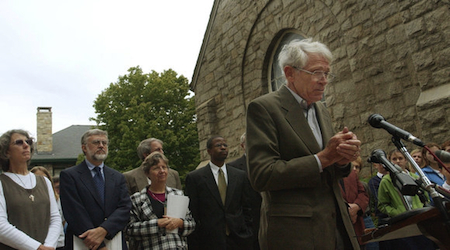
As we celebrate 90 years of faithful work for justice and equity this year, we’re sharing stories of 90 Years Rooted in Faith that reflect the heart of the North Carolina Council of Churches. Each month, you’ll hear from staff and long-time friends of the Council as they highlight the transformative impacts we’ve had on our community and our vision for the future. Stay tuned for these inspiring reflections throughout the year!
by: Jennifer Copeland, Executive Director with Collins Kilburn, Former North Carolina Council of Churches Executive Director
Most executive directors for the North Carolina Council of Churches stick around for a while. Collins Kilburn was no exception, leading the Council for 20 years from 1979—1999, after having worked as the Council’s Director of Social Ministry for the previous 10 years. While Director of Social Ministry, Collins served simultaneously as the Chaplain to the General Assembly. As Collins tells it, “When I was Chaplain to the legislature, I noticed how much of the legislative agenda overlapped with the Justice agenda of the Council.” From this noticeable overlap was birthed the idea of holding bi-annual Legislative Seminars to help churches map the intersection between the policies that bracket our lives and the justice ideals to which the scripture calls us.
When the Rev. Dr. Sam Wiley, Executive Director from 1964—1979, who had hired Collins in 1969, retired, Collins became the executive director and carried with him into that role his passion for legislative advocacy. Under his leadership, the Council began regularly to write position papers and policy statements to guide the work of the denominations and congregations under the Council umbrella.
Collins recalls with great appreciation the work of the Equal Rights Amendment working group, “probably one of the best working committees the council ever had.” Another notable program committee during his tenure was the Tobacco Working Group, which achieved national acclaim for their position that farmers stop growing tobacco as a moral obligation. Collins admits the acceptance of the Metropolitan Community Church as a member denomination “was probably the most controversial issue during my time.” Each of these examples demonstrate the truth that the Council is regularly out in front of where society and the church eventually goes.
But the highlight of his time leading the Council, according to Collins, was the visit of South African Episcopal Bishop Desmond Tutu to North Carolina at the invitation of the North Carolina Council of Churches and the North Carolina Diocese of the Episcopal Church. I, Jennifer, was in Duke Chapel that magical afternoon, as a student at Duke Divinity School. I wholeheartedly concur with Collins’ assessment, “One striking thing about Tutu’s message was the easy flow from the exposition of the gospel to the social and political implications. When you listen to Tutu, you know you are hearing the Word from the Bible and from the Christ event. At the same time, the political import is strong and clear.”
Collins Kilburn led the Council decidedly toward the integration of faithful justice goals with robust legislative advocacy. Collins exemplifies my often-repeated mantra that those of us working at the North Carolina Council of Churches stand on the shoulders of giants. Collins Kilburn stands tall among that cloud of witnesses.
