

A Call to Action
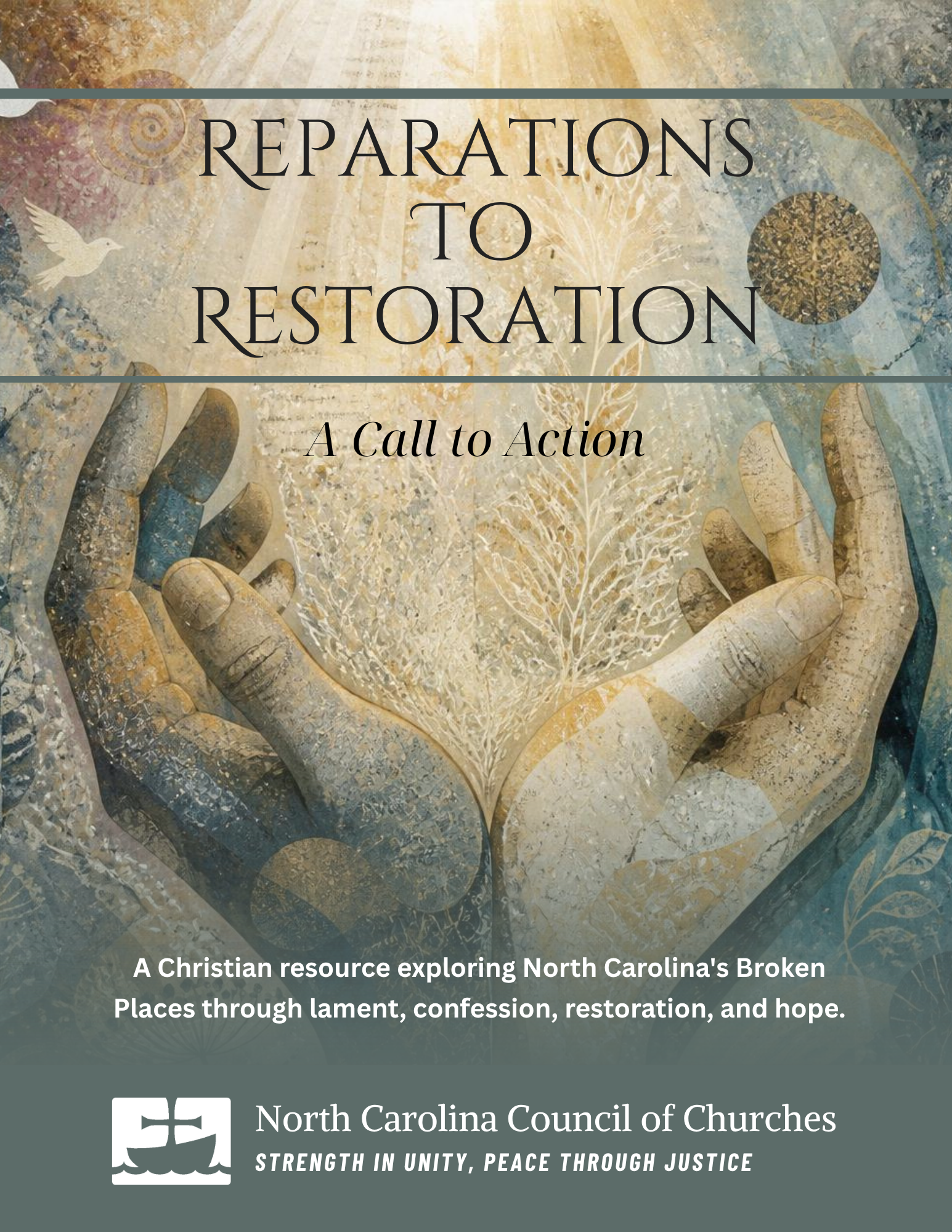
Reparations to Restoration: A Call to Action is a collaborative resource developed through the leadership of the North Carolina Council of Churches and ecumenical partners across North Carolina. Drawing on the expertise of clergy, theologians, practitioners, and community leaders from multiple Christian traditions, this resource invites people of faith into the work of lament, confession, restoration, and hope.
Explore the sections below to learn more about this resource.
Why this Matters
Over the course of time certain words acquire flashpoint status, where previously they had merely been words used as signifiers for objects or ideas. Reparations is such a word. Originally meant to signify the return of that which was stolen or denied from the one who deserved it, the word has now taken on different meanings based on who says it and who hears it. Those expecting to anti up have conceived all manner of excuses why they shouldn’t. Those expecting remunerations have started counting their unhatched eggs. Many fall along the spectrum of those two extremes. Reparations are a conversation stopper for many.
We intend to recast the conversation through the lens of Christian teaching, specifically the reconciling work God has accomplished through the life, teaching, death, and resurrection of Jesus. In Jesus, God offers the path to restoration. By focusing on restoration, we leave behind the language of debtors and creditors, victims and perpetrators, givers and takers. We move to a place of restoration by acknowledging the reconciling work that begins with God. All reconciliation comes from God, giving us the power to be reconciled with one another and reconciled within ourselves.
Grounded in the Christian principle of confession, repentance, and reconciliation we aim to show people of faith the places where systemic racism has benefitted whites and harmed others… Continue Reading.
The Framework

Each topic has the same arch: lament, confession, restoration, hope.
- Lament: We ground our work in lament, acknowledging pain and loss without rushing too quickly to confession. Lament calls us into places of empathy and asks us to identify with those who suffer.
- Confess: name the wrong
- Restore: Restoration offers many possibilities including restitution and repair.
- Hope: Not pollyanna optimism, hope is much deeper and long-lasting and should prompt us to action.
What You’ll Explore
This guide seeks to go further by naming specific failures and locating those failures within specific places. We call them “The Broken Places.” We have chosen only seven, but hope our way of presenting them can help all of us identify the myriad broken places surrounding us. We have located them in known places across North Carolina, not because those are the only places these failures occurred, but because the specificity of what occurred can shine light on the preponderance of the failures across our land.
Real Estate

Education

Environmental Racism

Health Disparities

Violence

Wealth Gap
Criminal Justice
Contributing Authors
The guide was edited and coordinated by Jennifer Copeland, Executive Director of the North Carolina Council of Churches, with significant research and writing support from Council interns Abigail Jordan and Incheol Kwag.
The North Carolina Council of Churches is deeply grateful to each contributor whose scholarship, lived experience, pastoral leadership, and commitment to justice shaped this resource:
Jennifer Copeland, Executive Director, North Carolina Council of Churches
Abigail Jordan, Research Intern, North Carolina Council of Churches
Incheol Kwag, Research Intern, North Carolina Council of Churches
Jay Augustine, Representative, African Methodist Episcopal Church
Ben Adams, Representative, North Carolina Conference, United Methodist Church
Carole Collins, Representative, Alliance of Baptists
Danielle DeNise, Representative, Evangelical Lutheran Church in America (North Carolina Synod)
Joanna Hipp, Representative, Presbyterian Church
Margaret Rowlett, Representative, Religious Society of Friends (Quakers)
Kathy Walker, Representative, Episcopal Diocese of North Carolina
LaShandra Astria, Representative, United Church of Christ
Wanda Floyd, Representative, Metropolitan Community Churches